

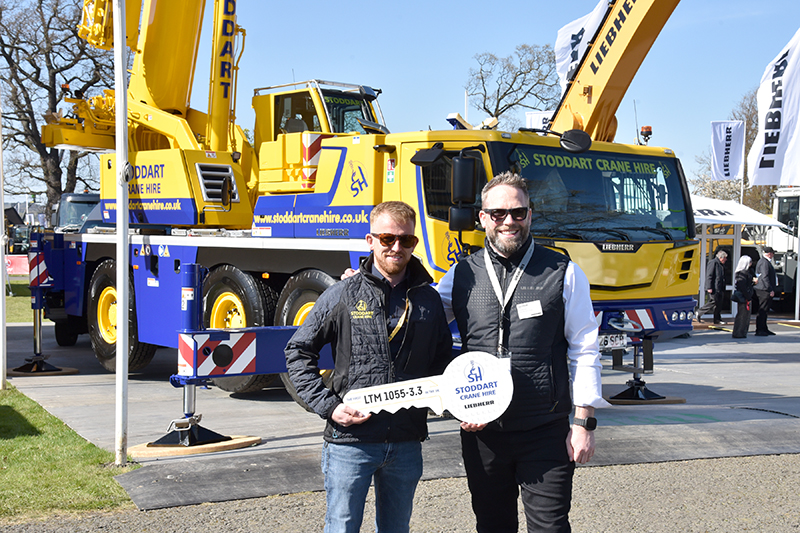
STODDART Crane Hire and Liebherr celebrated the handover of the UK’s first LTM 1055-3.3 all-terrain crane at ScotPlant 2026. The new 55-tonne model was showcased on the Liebherr stand at the exhibition. The crane will support Stoddart’s specialist operations across Scotland’s isles, where low axle loads combined with strong lifting performance are described as essential to meet infrastructure and access constraints.
The LTM 1055-3.3 was first unveiled at bauma 2025, where Liebherr and Stoddart Crane Hire agreed the deal. The three-axle crane features a 40-metre main boom, complemented by a 15-metre double folding jib, enabling lifting heights of up to 54 metres and radii of up to 46 metres.
In addition, Liebherr has developed a 1.9-metre assembly jib, which can be angled up to 50°. This is said to make it particularly well suited to assembly work in confined environments such as industrial halls.
The crane is equipped with technological innovations including the newest generation of the LICCON 3 control system and advanced driver assistance systems, which continuously scan the surroundings and provide warnings to the driver.
The model also features RemoteDrive, allowing both the superstructure and chassis to be controlled via radio remote control. This function, Liebherr explained, enables ‘precise and sensitive’ manoeuvring, making it ideal for restricted construction sites.
With a variety of driving modes, the LTM 1055-3.3 can be configured to achieve nine-tonne axle loads, allowing access to sites that may not be suitable for heavier cranes.
Kerri MacDonald, director of Stoddart Crane Hire, said, “We are extremely proud to take delivery of the first LTM 1055-3.3 in the UK. This crane has quickly become a vital addition to our fleet, due to its ability to be stripped down to nine tonnes per axle, enabling us to go further afield for our customer base across the Scottish Highlands and Islands. Sending it out on its very first job was particularly exciting, with the crane travelling by ferry to the island of Unst in the Shetland Islands.”